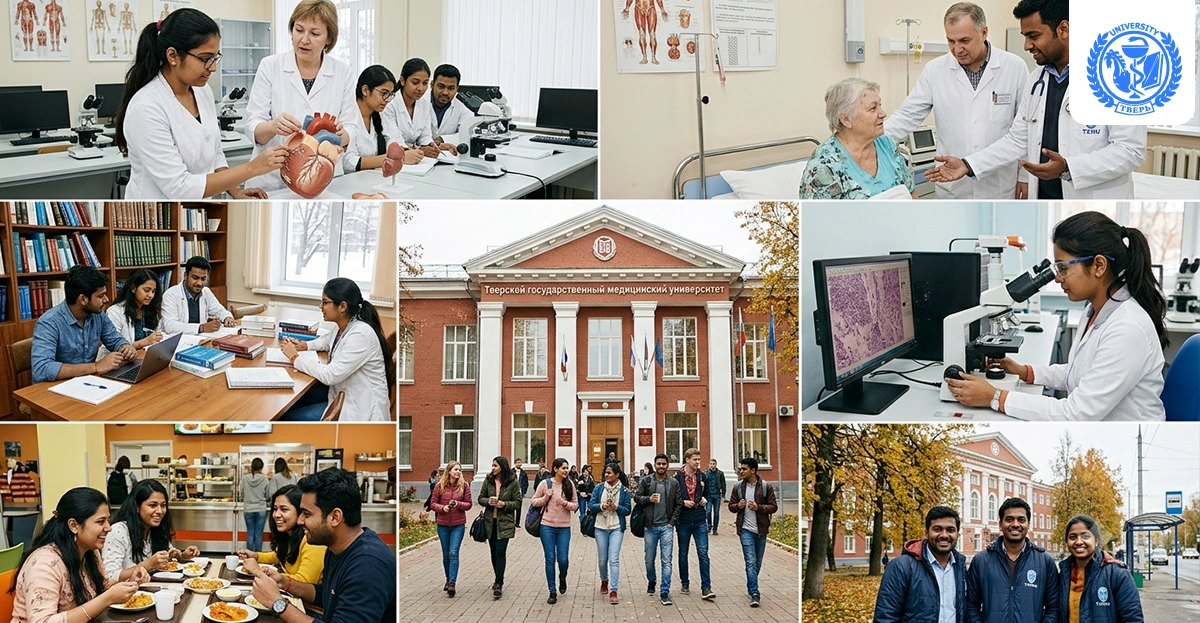
Every year, thousands of Indian medical aspirants look beyond India's limited NEET seats to trusted destinations abroad, and Tver State Medical University keeps coming up as one of the more reliable names on that list. Located in the historic Russian city of Tver, this government-run university has built a solid reputation among Indian families for pairing real affordability with genuine academic quality. But what actually sets it apart from the dozens of other options out there? Below are seven concrete reasons Indian students keep choosing it, from degree recognition to everyday campus life, plus the official TSMU admissions overview if you want to dig into specifics as you read.
Tver State Medical University at a Glance
| Particular | Details |
| University Type | Government (public) medical university |
| Established | 1936 |
| Location | Tver, Russia, about 150 km from Moscow |
| Course Offered | MBBS (General Medicine) |
| Duration | 6 years (5 years academics + 1 year internship) |
| Medium of Instruction | English, with Russian taught for clinical-year patient interaction |
| Recognition | Listed in the World Directory of Medical Schools (WDOMS) |
| Approx. Annual Tuition | ₹4.3–4.5 lakh (~430,000 RUB) |
| Indian Students Currently Enrolled | 1,200+ |
Figures are indicative and may change with the ruble-rupee exchange rate; confirm the current numbers with the university before applying.
7 Reasons Indian Students Choose to Study MBBS at Tver State Medical University
For Indian students who wish to pursue good medical education abroad, Tver State Medical University is a great option for pursuing studies of MBBS in Russia, thanks to its international atmosphere and increasing number of Indian students.
-
Global Recognition That Actually Holds Up
TSMU's MBBS (General Medicine) programme is listed in the World Directory of Medical Schools and meets the National Medical Commission's eligibility norms for Foreign Medical Graduates. In practice, that means graduates can appear for India's FMGE/NExT screening test after they return, the same pathway followed by every Russian medical university degree that's genuinely usable for an Indian medical career. The programme structure, five years of academics plus a compulsory one-year internship, matches what NMC expects from a foreign qualification, and TSMU is separately accredited by Russia's own Ministry of Science and Higher Education.
-
Tuition Without the Donation Culture
One of the most common complaints Indian families have about private medical colleges at home is the "donation" or capitation fee stacked on top of official tuition. TSMU doesn't work that way. Admission is merit-based, there's no separate entrance exam, and the university charges no application fee to international students. Annual tuition runs around ₹4.3–4.5 lakh, and a full six-year budget tuition, hostel, and living costs combined typically lands between ₹25–30 lakh. That's a fraction of what a management-quota MBBS seat costs in India, and it's a big part of why affordability keeps coming up whenever families explain their decision to study MBBS at Tver State Medical University.
-
Classes Are Actually Taught in English
Unlike universities that quietly shift to all-Russian teaching once clinical years begin, TSMU keeps its MBBS curriculum in English from day one. Russian is taught as a subject too, mainly so students can talk comfortably with patients once hospital postings start around the fourth year, but it isn't a requirement for passing exams. There's no IELTS or TOEFL score needed for admission either. For an 18-year-old walking into a foreign classroom for the first time, not having to relearn medicine in a second language removes one major source of stress.
-
Clinical Training Starts Early, Not in Year Five
TSMU pairs classroom teaching with hands-on exposure well before the final internship year. Students train across multiple affiliated hospitals and clinics around Tver, backed by simulation labs and modern diagnostic equipment, and from the second year onward can join research clubs alongside senior faculty. For anyone planning to sit FMGE/NExT or eventually USMLE or PLAB that early, repeated contact with real patients and real case discussions tends to matter more than lecture-hall theory alone.
-
Nearly Nine Decades of Medical Teaching
Founded in 1936, Tver State Medical University is one of Russia's older state medical universities, with a sizeable permanent faculty and a campus built specifically for medical education rather than retrofitted from something else. That includes a large medical library, well-equipped laboratories, and decades of accumulated clinical teaching experience. For a Russian medical university, that kind of institutional depth counts for something newer private medical schools simply haven't had the time to build comparable hospital partnerships or faculty experience.
-
A Genuinely Large Indian Student Community
TSMU currently has over 1,200 Indian students on campus, one of the bigger Indian cohorts among Russian medical universities, and the support system reflects that:
-
A dedicated Indian mess serving home-style food
-
Organised Diwali and Holi celebrations on campus
-
Cricket alongside volleyball, football, a gym, and a swimming pool
-
Centrally heated, CCTV-monitored, fully furnished hostel accommodation
For a first-year student thousands of kilometres from home, having seniors who've already navigated the visa process, the exams, and the early homesickness tends to matter as much as anything else on this list.
-
Close Enough to Moscow, Calm Enough to Study
Tver sits roughly 150 km from Moscow, close enough for an easy trip when students need a break or a visit to the embassy, far enough to avoid the cost and distraction of living in a capital city. It's a quieter, more affordable base for six demanding years of study. TSMU also runs integrated FMGE/NExT preparation support alongside the regular curriculum, so exam readiness isn't something students have to figure out entirely on their own after graduating from Tver State Medical University.
Conclusion
No single reason explains why Indian families keep choosing Tver State Medical University; it's the combination of a usable, recognised degree, real affordability, English-medium teaching, and a support system that doesn't leave students to figure things out alone. If you're weighing your options for MBBS in Russia, TSMU deserves a serious look rather than a passing mention. The practical next step: check the current fee structure and eligibility criteria, and get your specific questions answered before the next intake fills up.
FAQs
Is Tver State Medical University good for Indian students?
Yes, it's one of the more established choices for MBBS in Russia, with a large existing Indian student community, English-medium teaching, and fees well below private colleges in India.
Is Tver State Medical University recognized in India?
TSMU is listed in the World Directory of Medical Schools and meets the NMC's eligibility criteria for Foreign Medical Graduates, so its MBBS degree allows graduates to appear for the FMGE/NExT screening test.
What is the approximate total cost of MBBS at Tver State Medical University?
Including tuition, hostel, and living expenses, most students budget around ₹25–30 lakh for the full six-year programme. Confirm current figures directly with the university, since costs shift with the exchange rate.
Do I need to know Russian to study at Tver State Medical University?
No. Classes are taught in English throughout, though basic Russian is introduced to help with patient conversations once clinical rotations begin.
What do students say in their Tver State Medical University review?
Common themes include a supportive environment for international students, genuine hands-on clinical exposure, and a manageable balance between theory and practice; though, as with any university, individual experiences vary.